
The Language of Archetypes
Every sign of the zodiac carries an archetype — not a personality label, but a living pattern you can feel. A way of moving through the world that shows up across cultures, centuries, and individual lives.
You carry more than one. We all do. Some are loud in your life right now, others were loud ten years ago, others are waiting. And each one can show up at its best or at its worst — the same energy that makes someone extraordinary is the energy that, unchecked, makes them destructive.
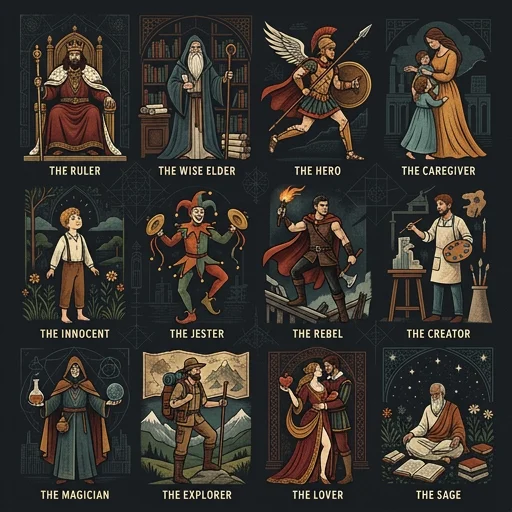
What follows are twelve of them, seen through different lenses. If you want to understand why this language works — and what it can do — there's more at the bottom.
Astrological Archetypes
Choose a sign to open it across all four lenses.
Every person below actually is the sun sign they're paired with. But that's not why they're here. They're here because in these moments, they were living their archetype so completely that the sign became visible — and anyone who has ever felt that same energy in themselves will recognize it instantly. We can all be any of these at various points in our lives, but in this moment or way, these people were exemplifying their sign at its best.
The press conference at the end of Iron Man. Every advisor told him to stick to the script, deny it, play it safe. He steps to the mic: "I am Iron Man." That's Aries. Not the fighting — the stepping forward when no one else will, claiming the thing before anyone's ready. The reason this lands is that RDJ is this. His entire career comeback is one long Aries move: walking back into the room that threw him out and daring them to say something.
Rwanda, 1979. Broadcaster David Attenborough is sitting on a jungle floor when a massive, wild mountain gorilla slowly approaches, climbs on top of him, and begins playfully examining his shoes and face. Attenborough doesn't flinch. He doesn't panic or retreat. He simply stays, perfectly grounded, whispering to the camera about the beauty of the moment. Taurus is Fixed Earth. The power isn't in explosive action or loud demands; it is a physical presence so calm, so undeniably rooted, and so deeply connected to the material world that even a wild apex predator recognizes it as a safe harbor.
Josephine Baker. To the public in Paris, she is the most famous, glittering, high-energy entertainer of her era. But during WWII, that dazzling exterior becomes a perfect cover as she operates as a spy for the French Resistance, smuggling military intelligence across borders written in invisible ink on her sheet music. And her shape-shifting didn't stop there. In one lifetime, she was a global superstar, a decorated military agent, a fierce civil rights leader speaking at the March on Washington, and the mother of a 12-child "Rainbow Tribe" adopted from across the globe to prove humanity could seamlessly coexist regardless of race. This is the highest expression of Gemini. Not "two-faced" but multiple simultaneous channels, all live, shifting in and out or all at once. The quicksilver mind that thrives precisely when conditions get chaotic because it can be five things at once.
1987. An AIDS ward in London. At a time when much of the world believed you could catch HIV through touch, she walks in without gloves and holds a dying man's hand. That's Cancer. Not sentimentality — the fierce, deliberate act of creating belonging for people the world has decided are untouchable. The Mother archetype isn't soft. It goes toward suffering. It says you are not alone here and means it with its body.
Super Bowl XXV, 1991. The National Anthem. She's not performing it. She's not interpreting it. She IS it. The entire stadium, the entire broadcast audience — they're not listening to a singer. They're watching the sun come up. That's Leo. Not ego, not performing — radiance. The thing that happens when a person is so fully themselves that everyone else just... orbits. She's not trying. The Sun never tries.
Coachella 2018. "Beychella." What the audience sees: transcendence, joy, spectacle. What made it: months of obsessive, body-breaking rehearsal. 200+ dancers in precise formation. Every light cue, every beat, every angle controlled. And the whole thing was in service of celebrating HBCU culture — not herself. That's Virgo. The perfection of craft in service of something that matters. The mastery looks effortless because the preparation was merciless. Most people think that kind of performance is Leo energy. It's not. It's Virgo. The difference is: Leo shines because they can't help it. Virgo shines because they prepared for a thousand hours and got every detail right.
"Imagine." That's it. "Imagine all the people..." The song IS the archetype. A world without walls, without division, without conflict — rendered as art so beautiful that even people who disagree with the politics can't stop listening. That's Libra. Not indecisiveness — the perception that harmony is possible and the artistic ability to make you feel it. The bridge between what is and what could be, built out of melody.
A dark shed in Paris. She's spent four years hand-refining pitchblende, ton after ton, boiling and filtering in a space with no proper ventilation. And then one night she walks in without a lamp and the substance she's extracted is glowing blue-green in the dark. Radium. Something no human has ever seen. Something that will kill her — is already killing her. She doesn't stop. She can't. That's Scorpio. Not darkness for its own sake — the willingness to go where no one else will go, to pull truth out of the hidden places, knowing it might destroy you, and choosing the truth anyway. The alchemist doesn't just transform things. The alchemist gets transformed.
A TV interview. Someone asks him to explain his philosophy. He says: "Be like water, my friend. You put water into a cup, it becomes the cup. You put water into a bottle, it becomes the bottle." Here's a man who left Hong Kong, came to America, studied every martial art he could find, threw out what didn't work, kept what did, invented something new, and then distilled the entire journey into a single sentence anyone can understand. That's Sagittarius. Not just travel — the quest for meaning that ends in a truth so simple it sounds obvious. The seeker who becomes the teacher.
August 28, 1963. The steps of the Lincoln Memorial. "I have a dream." The authority in that moment wasn't given — it was built, march by march, jail cell by jail cell, sermon by sermon. And the dream itself is Capricorn to its core: he's describing a structure. A future. Something to be built over generations he knows he may not live to see. And he builds it anyway. That's Capricorn. Not coldness — the long game. The willingness to lay a foundation you won't be around to live in because the structure matters more than you do.
December 1, 1955. Montgomery, Alabama. She doesn't give up her seat. That's it. One person, one act, one refusal — and an entire system cracks. Not for herself. For the principle. For the collective. For everyone who would come after. That's Aquarius. Not eccentricity — disruption in service of the future. The individual who acts on behalf of everyone. The revolutionary whose weapon is simply not complying.
Looking directly into a television camera and saying, "I like you just the way you are." And somehow, impossibly, every child watching believes he's talking to them personally. The screen dissolves. The distance dissolves. The boundary between stranger and intimate dissolves. That's Pisces. Not escapism — the ability to make boundaries stop being real. The radical empathy that says there is no separation between me and you. A TV screen should be a wall. He made it a window. Then he made it a door.
While astrology and ancient mythology are essentially two dialects of the same language, the literal origin stories of the constellations can sometimes be surprisingly obscure. Rather than getting mired in forgotten cosmic trivia, we are looking at the deepest psychological engine of each sign. For a modern audience, the figures below represent the most powerful, instantly recognizable manifestations of these archetypes from myths you likely already know—stories that capture the absolute essence of what it feels like to carry this energy.
The Myth: When the Trojan War began, the warrior Achilles was given a prophecy and a choice. He could stay home, live a long, peaceful, forgotten life. Or he could go to Troy, achieve immortal glory, and die young. He chose Troy.
The Meaning: Everyone knows about his "heel," but the core of Achilles is the choice. Aries is the spark of initiation. It is the archetype that looks at the safety of the known world, realizes that a life without passion is just a slow death, and willingly trades security to feel fully, gloriously alive.
The Myth: In Greek mythology, the Olympian gods were constantly flying around starting wars, having dramatic affairs, and causing chaos. Hestia, the goddess of the hearth, did none of this. She sat at the center of Olympus and tended the eternal fire. She never moved. She never fought.
The Meaning: She was the most revered of all the gods because without her fire, the entire divine family would freeze and collapse. This is Taurus (Fixed Earth). It is the unmoving center. The profound, stabilizing gravity that keeps everything else alive while the rest of the world spins in chaos.
The Myth: With his winged sandals, Hermes was the messenger of the gods. But more importantly, he was the only figure in the pantheon who had the clearance to freely travel between the heights of Mount Olympus, the mortal realm of Earth, and the depths of the Underworld.
The Meaning: Gemini is the ultimate networker and translator. The sign of the Twins isn't about being two-faced; it's about the mind's refusal to be trapped in one reality. Like Hermes, Gemini's power is the speed and bandwidth to cross boundaries, gather information from the dark, and deliver it to the light.
The Myth: The goddess of the Moon, Artemis is also the fierce protector of the vulnerable, specifically young women, children, and wild animals. She demanded total safety in her sanctuary. When the hunter Actaeon accidentally crossed her boundaries and saw her bathing, she didn't shrink away. She instantly turned him into a stag and let his own hunting dogs tear him apart.
The Meaning: Cancer is often soft-pedaled as "sweet" or "domestic." But Artemis reveals the true architecture of the sign. Cancer is the creator of the sanctuary. It is an incredibly sensitive, nurturing energy that demands a safe harbor, and if you cross its emotional boundaries or threaten what it loves, you will immediately trigger a terrifying, lethal defensive instinct.
The Myth: He is the god of music, poetry, and most famously, the Sun. Every day, he drives the golden chariot across the sky, bringing light to the world. He doesn't chase the light; he is the light.
The Meaning: This is the purest expression of Leo sovereignty. The sun doesn't shine to get attention; the sun shines because it is its nature to radiate, and in doing so, it gives life to everything orbiting it. Leo energy at its highest is the kind of quiet, absolute confidence that gives everyone else in the room permission to warm themselves by the fire.
The Myth: During the Golden Age, gods lived among men. But as humanity grew corrupt and violent, the gods fled back to the heavens in disgust. Astraea, the goddess of innocence and justice, was the very last immortal to leave. She stayed behind as long as she could, endlessly trying to fix humanity, believing we could be made right.
The Meaning: When she finally gave up, she became the constellation Virgo. It is the ultimate metaphor for Mutable Earth. Virgo is the archetype of the craftsman, the healer, the editor, the one whose deep love for the world shows up as a tireless compulsion to fix every broken detail.
The Myth: A Titaness from Greek mythology, Themis is the ancient embodiment of divine order, fairness, and custom. We still build statues of her in front of every courthouse today: the woman holding the scales, completely blindfolded.
The Meaning: The blindfold is the key to the Libra archetype. Libra is not just about "liking pretty things." The blindfold represents the monumental effort to strip away ego, bias, and visual noise to actually weigh the truth of a situation. Themis holds the scales because Libra carries the massive, exhausting burden of constantly evaluating both sides of every single equation to maintain harmony in the world.
The Myth: She was the innocent daughter of the harvest, abducted into the Underworld by Hades. But the crucial turning point of the myth isn't her capture, it's her choice. While in the dark, she is offered a pomegranate. She chooses to eat the seeds, knowing it binds her to the realm of the dead.
The Meaning: She doesn't remain a victim; she becomes the feared and revered Queen of the Underworld. This is the core of Scorpio. True transformation means going into the dark, facing the terrifying shadow parts of the psyche, and rather than fleeing back to the surface in denial, choosing to integrate them and achieve sovereignty over them.
The Myth: While most centaurs were wild beasts, Chiron was an immortal scholar, philosopher, and the teacher of humanity's greatest heroes. Ironically, he was struck by a poisoned arrow that he, despite all his medical knowledge, could not heal.
The Meaning: He is the archetype of the "Wounded Healer." Sagittarius is the seeker, the philosopher, the world-traveler. The myth reveals that the wound becomes the path to wisdom, pushing them to search the ends of the earth for answers.
The Myth: We still see him every New Year's Eve: the old man with the scythe and the hourglass. In myth, he is Chronos, the god of time, limitation, and consequence. He reaps what is sown.
The Meaning: Capricorn is the architect. It is the energy of confronting the hardest reality of human existence: we have limited time. Saturn teaches that nothing lasting can be built without discipline, delay, and structure, and that true authority is painstakingly earned over decades.
The Myth: The gods kept fire, representing technology, civilization, and enlightenment, for themselves, leaving humanity to freeze in the dark. Prometheus stole it, handed it to mortals, and was chained to a rock to endure horrific punishment for eternity.
The Meaning: Every Aquarius is Prometheus. It is the rebellious visionary who sees a system that is fundamentally unfair, breaks the rules to distribute power to the collective, and willingly accepts being alienated or punished by authority because liberating humanity is worth the cost.
The Myth: When his wife Eurydice died, Orpheus walked into the Underworld armed with nothing but a lyre. He played music so achingly beautiful that the Furies wept, the damned stopped suffering, and the god of the dead allowed his wife to return to life.
The Meaning: Pisces is the final sign. It is the energy that dissolves every boundary. Where Capricorn builds walls, Pisces proves they are illusions. Through art, empathy, and raw spiritual feeling, the Piscean archetype proves that even the ultimate boundary, the line between life and death, can be crossed through love.
The first two lenses — the Modern and the Mythic — are inherently loud. They happen on global stages, in history books, and in legendary epics. But astrology’s real magic isn’t just explaining Beyoncé or Achilles; it’s explaining us. For the system to be true, the archetypes can’t just be grand, sweeping destinies. They have to be ordinary moments. They have to be verbs. What follows aren’t famous people or ancient myths — they’re scenes you’ve lived. Moments where someone near you was quietly embodying a planetary energy so completely that it shifted the gravity of the room. You’ll know who they are. You might realize you’ve been one of them. This is what it looks like when an archetype is waiting to be recognized in the everyday.
The Scene: You're in a meeting. Someone asks a question and the room goes dead silent. Everyone's eyes drop to the table. You feel the crushing, terrified discomfort rise in the room. And then, one person raises their hand. Not because they are certain they have the right answer, or because they want to show off. Because the silence was worse than being wrong. You know who raises that hand. You've watched them do it a hundred times.
The Scene: Your life is completely spinning out of control. You walk into their house—maybe a grandmother, maybe a trusted uncle, maybe an old friend—and they don’t frantically try to solve your problems. They just put the kettle on. The mug is in the exact spot it was five years ago. They are exactly as they were five years ago. Out there, the world is chaos. In here, the bread is rising. The dough is being kneaded, or the wrench turned, as they listen. Their refusal to panic, their radiating calm, their sheer, quiet immovability in the face of your storm, is the exact thing that saves you.
The Scene: You bring a new person to a gathering. They're anxious, they don't know anyone, and the vibe is a bit jagged. Unprompted, this friend sits down next to them. Within thirty seconds, they have found the exact, obscure frequency this stranger operates on, matched it perfectly, and completely plugged them into the room's electrical grid. They don't just talk; they adapt. They are the human connective tissue that bridges any gap.
The Scene: You show up at their door completely exhausted and raw, and you instantly feel like your presence is WANTED. They don't try to entertain you. They don't expect you to be witty or put together. They hand you a blanket, put food in front of you, and give you the quiet, fierce permission to simply collapse. You don't remember taking your shoes off, and you realize you've been holding your shoulders up by your ears for weeks, and you didn't even notice until their sanctuary gave your nervous system permission to drop the armor.
The Scene: It's your first day at a new job or a new school. You're standing at the edge of the room, holding your tray, scanning for a corner to disappear into. And someone across the room makes eye contact, smiles freely, and waves you over. "Come sit with us." Not because they were told to. Not out of pity. But because it literally didn't occur to them not to. Generosity so absolute and uncalculated that it warms you instantly. They are the sun, and they just invited you into the light.
The Scene: It's midnight. Your resume is due tomorrow for a job that could change your life. Your friend — the one who's meticulous about things — is still up, and you send it over half-hoping they'll just say "looks good." Instead they send it back with every comma fixed, every verb tightened, and a note that says "your second bullet point undersells you, say this instead." Devotion, for them, is a verb. They believe the details are what stand between you and the life you deserve, and they want your life to go well.
The Scene: It's a dinner party with people who hold totally different worldviews. It should be a disaster. But this magician is sitting at the center, subtly shifting the conversation, elevating a point, defusing a tense moment with a perfectly timed laugh, interrupting just when a pause is needed. Somehow everything that could have tipped out of balance stays just within bounds. It's the invisible architecture of social grace. The room's friction is absorbed so completely that everyone walks away thinking they themselves are brilliant, and so glad they came.
The Scene: You're at dinner with a friend. Everyone is doing the exhausting "I'm fine" dance. And then this friend looks across the table, makes dead-center eye contact, and asks quietly, "How are you actually doing?" And waits. Sits in the silence and waits. They already know the answer isn't "fine." They knew before they asked. They're not going to let you perform your way through this meal. And in that moment you have a choice: keep the mask on, or trust them with what's underneath. And somehow you do. Because they asked like they could handle it.
The Scene: It's 2am. You're on a sidewalk outside a bar. You came for a drink, but somehow a conversation started — about life, about meaning, about a truth you'd never said out loud. Now you're both standing in the cold and neither wants to leave because the conversation isn't done. When it finally ends, you walk home seeing the world differently. Not because they lectured you, but because they asked a question that rearranged everything you carried.
The Scene: You're on a messy, chaotic group trip. Everyone is disorganized, arguing about where to eat or how to get to the train. Then someone quietly steps away, figures out the transit schedule, makes the reservation, and simply points the group to the door. They took on the heavy, unglamorous load of reality. They did it without asking for a thank you or making a speech, so that every single other person has the luxury of being carefree.
The Scene: You're in a group, and everyone is nodding along to something—a bad plan, an unfair decision, a thing the boss just said. You feel the wrongness of it in your chest, but no one is moving. Then, one person speaks up. "I don't think this is actually right." Not loudly. Not dramatically. Just clearly. The room entirely shifts. Later, three people privately admit they felt the same way but were too scared to say it. This person spoke because to them, the principle mattered more than the comfort of belonging.
The Scene: You’re on the subway right after something humiliating or completely heartbreaking has happened to you. You are trying so hard to hold it together. You look up, and a total stranger catches your eye. They don’t say a word. But their expression is so completely devoid of judgment, and so filled with absolute, silent understanding, that your throat catches. For three seconds, on a crowded train, the boundary between you completely dissolves. They felt your pain in their own chest, and let you know you weren’t alone.
Every archetype has a shadow. When the same energy that makes a sign powerful turns inward or runs unchecked it can manifest in a variety of ways — these are some examples of what this looks like.
Most of these patterns started as something that worked. A survival strategy that made sense in a specific moment, a way of coping that genuinely helped, a strength that got someone through something real. And then it became a habit, or an identity, or the only option that felt safe — and the person inside it got stuck. Not because they're broken, but because the thing that once protected them quietly became the thing that's costing them. These aren't character flaws. They're places people get lodged, often for entirely understandable reasons.
Some of these patterns are obviously painful. Others — and this is important — can look like strengths. Some of the most entrenched imbalances show up as tireless generosity, perfect composure, relentless self-improvement, or saintlike devotion. They draw praise. They look like the sign at its best. But underneath, the same compulsive engine is running, and the cost is hidden — sometimes even from the person paying it.
If you recognize yourself in any of these patterns, you are not alone. The Star Cycle explores the journey from these states toward balance.
Aggression without direction. Starting fights instead of starting things. The fire that once meant courage hardened into permanent combat readiness — everything a battle, including the relationships that just needed softness. The hand that raises first but never learned to listen, the charge forward that can't slow down because slowing down feels like dying. Some of the ways this can manifest:
The land mine — the anger usually started as protection — in a home, a neighborhood, a situation where being ready to explode was the difference between surviving and not. Now it's the only setting they have. Their partner checks their mood before bringing anything up. Their kids learn to read the room before they learn to read. They'll tell you they're not angry — they're just honest, just direct, just someone who doesn't take shit. Everyone else is just too sensitive. For what it sounds like when someone living this pattern starts to see its cost, hear Starshadow's Heavy to Carry.
The one who has to win — turns everything into a contest. Can't hear someone's good news without measuring it against their own. Arguments aren't conversations, they're things to win. The friend whose energy makes everyone around them feel like they're always slightly losing. Somewhere along the way, "second place" became indistinguishable from "worthless."
The one-person army — learned early that nobody was coming to help. So they stopped asking. Asks for nothing, accepts nothing, does everything themselves. Exhausted and resentful about it. Every offer of help lands as an accusation of weakness. Always fine — jaw tight, shoulders up, grinding through alone — and furious that nobody notices what it costs them.
The flight risk — jobs, relationships, cities. Not toward something — away from stillness. Can't sit with what's in front of them because sitting still feels like suffocating. Everyone around them has whiplash from the last sudden departure they didn't see coming. They'd call it following their instincts. It's closer to outrunning them.
Holding on so tight they crush what they love. Comfort that became a fortress, stability that became a refusal to move even as the ground shifts beneath them. The rootedness that once grounded everyone turned to dead weight — the person whose strength was always their steadiness, but the steadiness has become a trap they can't distinguish from safety. Possessiveness disguised as devotion. (Starscream's Die On This Throne inhabits this territory — the defiance, the grip, the terror that movement means dissolution.) Some of the ways this can manifest:
The hoarder — not always physical, though sometimes. The person who accumulates and never lets go — stuff, money, routines, relationships long past their expiration. The grandmother's house where nothing has been moved in thirty years. The storage unit full of things they'll "need someday." Releasing anything feels like losing a piece of themselves, because at some point it became true.
The rock — the most deceptive one, because from outside it looks like the healthiest Taurus there is. The person everyone depends on, everyone leans against, everyone praises for their steadiness. But their consistency is actually rigidity in disguise. They're not grounded — they're frozen. They can't change, can't adapt, can't grow, but it looks exactly like strength to everyone relying on them. And the praise keeps them locked in place. Can resemble Capricorn's emotional stoic, but where Capricorn is frozen by the need to maintain authority, Taurus is frozen by the terror of movement itself.
The possessive partner — often someone who lost something they loved and decided, consciously or not, that it happened because they weren't holding tight enough. "I love you" that means "you're mine." Jealousy disguised as protectiveness. Will do your taxes, manage your calendar, handle the bills — not out of generosity but to make you believe you can't function alone. Love that slowly closes every exit until devotion and dependency are the same thing.
The lifer — the job they've hated for a decade that they'll never quit. The relationship that ended years ago but they're still in it because the disruption of leaving is more frightening than the deadness of staying. They chose this once, maybe — but that was a long time ago, and now it's a sentence they're serving voluntarily. Their comfort zone became a coffin and they furnished it.
The brick wall — every time they were flexible, someone took advantage. So now nothing gets through. Will not engage with a new idea, a different perspective, a changed circumstance. Not ignorant — immovable. They decided their position before you opened your mouth, and nothing you say will move it. Conversations go nowhere. Arguments end where they started. The ground does not shift.
The one who numbs with comfort — pleasure, food, spending, routine used as sedative. Not "liking nice things" — using nice things to avoid feeling anything that might require change. Often someone who once experienced real deprivation or instability, and the comfort that saved them became the only language they speak. The anesthetic that was once grounding has become the whole world, and they've stopped being able to tell the difference.
So many channels open that none carry a real signal. Words without weight, connection without depth. The quicksilver mind that was once a gift for bridging worlds spinning so fast it can't land anywhere. The translator so busy converting everyone else's frequencies that they've lost their own signal entirely. Some of the ways this can manifest:
The BSer — so good at talking they can talk their way into or out of anything, and at some point stopped caring whether what they're saying is true. Not malicious — just disconnected from their own sincerity. Words became tools a long time ago, and now they're not sure they remember how to mean what they say.
The devil's advocate — argues every point from every side, not because they believe any of them but because the intellectual exercise is irresistible. Will take apart someone's deeply held belief as casually as solving a puzzle, and genuinely not understand why they're upset. The mind so fast it's completely disconnected from the emotional impact of its own words. "I was just playing with the idea" — while the person across from them is in tears.
The gossip — knows everything about everyone, not from depth but from network. Information as social currency, connection as data-gathering. They're the hub of every circle but nobody actually trusts them with anything real, and the loneliness of that is something they fill with more information.
The chameleon — so adaptable they've lost a fixed self. Different person with different groups. Can match anyone's frequency so perfectly that you start to wonder which one is the real them. They probably wonder too. The adaptability that once made them welcome everywhere has left them a stranger to themselves.
The one who can't stop talking — fills every silence, every pause, every breath with words. Not because they have something to say but because silence feels like a void that might swallow them. Conversations with them are exhausting because nothing ever quite lands — the next sentence arrives before the last one has finished meaning anything.
The surface connector — knows five hundred people, none of them deeply. Everyone's fun friend, nobody's real one. Skims the top of every relationship because going deep would mean holding still, and holding still would mean being trapped on one frequency. The breadth that was once exciting has become a way of hiding from intimacy.
The nurturing instinct turned into a cage — theirs and everyone else's. Love so fierce it smothers, protection so total it becomes a prison. Walls built to keep the world's pain out that ended up keeping everyone else locked in — or locked out. The one who carries everyone's feelings and then weaponizes the weight of it. Some of the ways this can manifest:
The saint — the most deceptive one, because it looks like the healthiest Cancer there is. Gives everything, holds everything, anticipates every need before it's spoken. Everyone around them thinks they're incredible — and they are, in a way. But the giving has quietly become a system. They've made themselves so indispensable that the other person can't function without them, and can never leave. Their own pain is dismissed as irrelevant — just weather, just the cost of doing love right. Their exhaustion is proof of devotion, not a signal to stop. It looks like the most beautiful love in the world, and it's the most binding.
The smotherer — love so total it suffocates. Can't let you make your own mistakes, can't let you be cold or hungry or uncomfortable, can't stop asking if you're okay. The parent who won't let their teenager close the door. The partner who can't give you a night alone. They learned that love means anticipating every need, and they can't stop, even when the need being expressed is for space.
The guilt tripper — "after everything I've done for you." Gave and gave and gave, and now holds the ledger. Every act of care was an entry in a book you didn't know they were keeping. Their love came with terms and conditions you're only now reading. Often someone who was genuinely taken for granted and decided, never again — but the accounting has taken over the love. Other signs manipulate through different currencies — Leo through generosity, Scorpio through intimate knowledge, Libra through composure — but Cancer's currency is guilt, and it's devastatingly effective because the care was real.
The martyr — sacrifices everything and suffers conspicuously so everyone can see the cost. The suffering IS the communication — it's how they say "look how much I love you" without saying it. Different from Aries's one-person army, which is about fierce independence — Cancer's martyr is about devotion made visible through pain.
The crab shell — withdrawn behind walls so thick no one can get in. The world hurt them deeply enough that they sealed the sanctuary from the inside, and now it's an isolation chamber. Not Scorpio's distrust, which comes from seeing too much — Cancer's shell comes from feeling too much. They're not suspicious of people. They're just too tender to risk it again.
The one who needs to be needed — has built their entire identity around being indispensable. When no one needs them, they don't know who they are. Will unconsciously create dependency or crisis to feel essential. The helping that was once genuine has become the only way they know how to exist.
The light that burns because it can't stop shining. Radiance turned desperate — performing instead of being, applause confused with love, generosity that was always, underneath, a contract. The warmth that once lit up every room now demanding that the room pay for the privilege. (Starscream's Solar Apex inhabits this energy in full, triumphant conviction.) Some of the ways this can manifest:
The light that forgot other suns exist — not the clinical diagnosis, but the archetype everyone recognizes. The person who turns every conversation back to themselves. Every room they enter reorganizes around them, and they've stopped noticing that it's happening. Not because they're malicious — because they genuinely cannot perceive that the sun might not be the center. Often someone whose early life gave them either too much validation or not nearly enough.
The performer who forgot they're performing — from outside, this looks like pure charisma — the person who lights up every room, who everyone wants to be around. But the mask became the face. Can't be alone, can't be ordinary, can't have a moment that isn't "on." The personality has consumed the person, and the real self has been backstage so long nobody remembers what they look like — including them.
The generous one with the invoice — gives spectacularly, visibly, memorably. And then watches to see if you noticed. Every gift, every favor, every act of warmth has an invisible string — pull it and you find an expectation of praise, attention, or devotion. Love as a transaction nobody agreed to. Can look like Cancer's guilt tripper, but the currency is different: Cancer's invoice is paid in guilt and obligation, Leo's is paid in attention and admiration.
The one who can't share the spotlight — someone else's good news diminishes them. A room's attention on another person feels like a personal loss. Not exactly jealous — more like the sun noticing another light source and feeling existentially threatened. Often has no idea they're doing it.
The eye for detail that lost the larger picture. Perfectionism that paralyzes, criticism that destroys — turned inward first, always, and then outward. The devotion to craft and service pushed past its limit, until the helping has become compulsive and the standards have become a prison. The one who can see every flaw and forgot how to see anything else. Some of the ways this can manifest:
The perfectionist — can't ship it, can't submit it, can't call it done because it's not right yet. And it's never right yet. The standard is so impossibly high that nothing is ever good enough to begin, and the paralysis looks like procrastination but it's actually terror. Often started with someone whose early work was met with relentless correction — so they learned to correct first. Can look like Capricorn's drive for achievement, but the engine is different: Capricorn pushes to produce, Virgo freezes because nothing is worthy of being produced.
The critic — sees every flaw in everything. The movie everyone loved? They noticed the continuity error. The meal you spent hours cooking? The salt was slightly off. Their own work? Garbage. It started with themselves — always does — and spread outward until beauty became invisible and all that's left is what's wrong.
The fixer — can't stop improving people who didn't ask. The partner always gently suggesting better habits, better clothes, a better way to organize the kitchen. Love expressed as correction. They genuinely believe that love IS optimizing your life — that if they're not making you better, they're not earning their place. They don't understand why you're hurt. They were trying to help. Other signs over-give for different reasons — Cancer to be needed, Pisces to merge — but Virgo over-gives to improve, because imperfection in the people they love feels like a personal failure.
The invisible servant — has poured so much into everyone else's details that they have no idea what they themselves want. Ask them where they want to eat and they'll stare at you. They've been so busy making everyone else's life seamless that their own has become an afterthought. Underneath it, often, is the quiet terror that if they stop being useful, they have no reason to be here at all.
The scales tipped so far toward balance that the person holding them disappeared. Keeping the peace at any cost, including their own truth. Or — in the other direction — fairness weaponized into something surgical and devastating. The same sign produces both: the one who vanished into accommodation and the one who turned elegance into a courtroom. (Starscream's Category Justice inhabits the weaponized version in full, poised conviction. For what it sounds like when the self-erasure version starts to crack, hear Starshadow's The Middle With No Me.) Some of the ways this can manifest:
The people-pleaser — has said yes so many times they've forgotten what they actually want. Mirrors everyone, agrees with everyone, smooths everything — and is slowly disappearing inside the accommodation. The person who's so agreeable you realize you have no idea who they actually are. Neither do they. This disappearance can look like Pisces's dissolution or Virgo's self-effacing service, but the engine is different: Libra disappears through accommodation, Pisces through absorption, Virgo through usefulness.
The elegant prosecutor — fairness turned into a weapon. Keeps meticulous score. Every imbalance catalogued, every slight weighed, and the case presented with devastating composure. They'll destroy you and look beautiful doing it. Never raises their voice — doesn't need to.
The one who can't choose — paralyzed at every fork. Can't pick the restaurant, can't commit to the plan, can't decide whether to stay or go. Every choice means losing something beautiful on the other side, so they hover in the middle until the choice makes itself — usually badly.
The conflict-phobic — will do anything, sacrifice anything, absorb anything to avoid a fight. Keeps the peace at a cost only they can see. The relationship looks calm from the outside because they're metabolizing all the conflict internally, and it's eating them alive.
The one who can't tolerate the mess — aestheticizes everything, including their own pain. Emotional mess repackaged as elegance. Can't sit with anything raw or unfinished or imperfect because the gap between the ideal and the actual is physically painful. Will stay in a dead relationship because the shared friend group, the beautiful house, the image of the "perfect couple" look too good to dismantle — even though there's nothing left inside it. Often someone whose early life was chaotic enough that beauty became the only reliable refuge.
The penetrating insight that turns paranoid. Obsession disguised as depth. Trust so broken that intimacy becomes a power game. Can't let go of anything — grudges, pain, people — because releasing control feels like dying. The alchemist who stopped transforming and started hoarding. The descent that was meant to be a passage through, turned into a place to live. Some of the ways this can manifest:
The one whose insight turned corrosive — the one who sought truth with such fervor, in all its nuance and complexity, that they got lost in it. Nothing is clean, nothing is pure — there's always another layer, a "yes, but," a darker side. The world's complexity flattened to a single, certain, profoundly dark conclusion: it's rot all the way down, and anyone who doesn't see it is asleep. (Starscream's The One Who Knows is an audio exploration of this thread.)
The therapist friend — looks like the most emotionally mature person in the room. Always asking the deep questions, always holding space, always going beneath the surface. Everyone thinks they're extraordinary. But it's a one-way mirror — they know everything about you and you know nothing about them. They use depth to avoid being seen, not just to see. Intimacy as a hiding place. The person whose emotional intelligence is real but has been turned into a way of staying in control without anyone noticing.
The one who never forgives — the original betrayal was usually real, and devastating. But now every slight gets the same treatment. Photographic memory for every moment someone let them down — can produce the receipts from ten years ago as if it happened this morning. The sibling they haven't spoken to in years. The ex whose name still changes the temperature of the room. Nothing is released, nothing is processed, nothing is allowed to be over. This can look like Taurus's grip or Cancer's clinging, but the object is different: Taurus holds what they have, Cancer holds who they love, Scorpio holds what hurt them.
The one who remembers everything — learned early that knowing things was the only reliable safety. Their attention felt intimate and flattering, until the day they used what you told them at 2am against you in a fight. Every vulnerability you ever shared has been filed. Every secret you offered in trust is available inventory. Closeness with them is a kind of surveillance you only recognize in retrospect — and by then they have everything they need.
The attention that became a closed loop — the ex's social media checked daily, two years later. The person who still drives past the old house. The intensity that was once genuine passion now running on its own, a fixation they can't shut down even when they know it's consuming them. Most people carrying this energy aren't doing anything criminal — they're checking, circling, unable to release their attention from someone who's gone. But in its extreme form, this is exactly what it sounds like.
The self-prosecutor — often someone who was told early that they were too much, too intense, too dark. Has done so much "inner work" that it's become its own form of suffering. Self-awareness used as self-punishment. Analyzes their own motives until nothing they do feels genuine anymore. Convinced that whatever is good in them is a mask over something worse.
The seeker who stopped seeking and started preaching. Reckless and certain in equal measure. The arrow that never lands — fired with real passion, toward something real, but the commitment to the quest has become a way of avoiding everything the quest was supposed to find. Freedom that became a prison of its own. Some of the ways this can manifest:
The dogmatist — started as someone genuinely hungry for truth, and found something real. The problem is they decided they found all of it. Has the absolute, unshakable certainty that they have found The Truth, and anyone who disagrees is simply unevolved. Will use philosophy, spirituality, or "growth" to bludgeon people — and call it teaching. The guru energy that accepts no questions, wrapped in the language of openness. Can resemble Scorpio's corrosive insight, but where Scorpio's certainty is dark — "it's all rot underneath" — Sagittarius's certainty is bright: "I've found the answer and you haven't."
The eternal tourist — collects countries, experiences, workshops, certifications, relationships — and integrates none of them. Always moving to the next thing because the depth is always somewhere else. Not Aries's flight risk, which is running from stillness — Sagittarius is running toward meaning and never finding it because they won't stay anywhere long enough for it to arrive.
The commitment-phobe — calls it "freedom." Won't be pinned down to a plan, a person, a place, an identity. Every boundary feels like a cage. Every promise feels like a trap. The partner who won't define the relationship after two years. The friend who confirms plans and cancels the day of. Often someone who watched commitment go badly for the people around them and decided: never me.
The reckless optimist — so focused on the big picture they destroy the details. Leaps before looking because looking feels like hesitation and hesitation is death. Leaves a trail of practical wreckage — missed bills, broken promises, abandoned responsibilities — while chasing something they'll recognize "when they see it."
Cold, rigid, measuring everything by what it produces. The builder who forgot why they started building. The long game that lost sight of the finish line — or reached it and felt nothing. Working so hard to earn love that they've forgotten love isn't something you're supposed to earn. Structure that once served life now replacing it. Some of the ways this can manifest:
The workaholic — has replaced every human need with productivity. Sleeps at the office. Answers emails at their kid's birthday party. Has achieved everything they set out to achieve and feels nothing, but doesn't know what else to do, so they set the next goal. Often someone who discovered early that achievement was the only reliable way to be valued — and never found another one.
The one who measures everything — can't experience anything without evaluating its return. Relationships assessed by what they provide. Friendships ranked by utility. Love subjected to a cost-benefit analysis. Not because they're heartless — because somewhere they learned that if it can't be measured, it isn't real, and if it isn't useful, it's indulgent.
The authority fortress — has built such an impenetrable structure of competence, status, and control that no one can ever make them feel small again. The fear of humiliation drives everything — every promotion pursued, every weakness hidden, every vulnerability sealed behind a title or an achievement. The person everyone respects and nobody knows.
The emotional stoic — cut off access to their own softness so long ago they can't find the door anymore. Won't cry, won't ask, won't admit to needing anything. The person everyone leans on who has never leaned on anyone. Strong in a way that has become its own kind of prison. This can look like Aries's armor or Aquarius's detachment, but the engine is different: Aries can't be vulnerable because toughness is survival, Aquarius because feeling threatens their independence, Capricorn because softness looks like weakness and weakness means losing everything they've built.
The one still earning love — works tirelessly for approval that should be freely given. The child who learned early that love was conditional on performance, and has never stopped performing. Every achievement is another payment on a debt that was never real, and no amount of success makes the bill go away.
Loves humanity in the abstract, can't connect with the person sitting across from them. The visionary whose vision has become a way to avoid the present. Principle elevated so high above feeling that the person underneath has gone numb — and is calling it evolution. The rebel who forgot what they were rebelling for. Some of the ways this can manifest:
The cold idealist — passionate about justice, equality, the future of humanity — and completely unavailable to the person in front of them. Will give a speech about compassion and then forget to ask their partner how their day was. Loves the species, struggles with the specimens. Often someone whose early emotional life was complicated enough that ideas became safer than people.
The contrarian — says no before they know what they're saying no to. Disagrees on reflex. If everyone agrees, something must be wrong. Started as genuine independent thinking and became a compulsion — they can't agree even when agreement is true, because agreeing means belonging and belonging means losing themselves.
The one who's too evolved to feel — has reframed emotional distance as spiritual or intellectual progress. "I've worked through that" means "I've walled it off." Detachment marketed as enlightenment. The person who's transcended so many feelings they've basically transcended being a person.
The professional outsider — so identified with not fitting in that belonging feels like betrayal. Can't join anything without immediately critiquing it. Can't be part of a group without maintaining ironic distance. The rebel whose rebellion has become the only identity they have, and they're terrified of what's underneath it. Can resemble Gemini's surface connector — both struggle to fully land in a group — but Gemini skims because depth means being trapped, while Aquarius holds back because belonging means losing themselves.
Dissolving into others until there's no self left. Boundarylessness that was once a gift for empathy turned into a way of disappearing. The one who feels everything, absorbs everything, gives everything — and wakes up one day with nothing left that's theirs. Escapism not as weakness but as the only available mercy for a nervous system that never learned to filter. Some of the ways this can manifest:
The disappearing act — dissolves into whoever they're with. Different taste in music depending on the partner. Different opinions depending on the room. Not Gemini's chameleon, which is mental adaptability — Pisces's dissolution is emotional. They genuinely become the other person's feelings, and when they're alone, there's terrifyingly little left.
The one who pays to belong — every act of kindness is a deposit. Every "it's fine" is currency. They've been bribing their way into love for so long they don't know any other way — and the sickening realization, when it comes, is that if they stopped paying, they'd find out who actually cares. And they're terrified of the answer. For what it sounds like when someone living this pattern starts to see its cost, hear Starshadow's Unpaid.
The empath who drowns — feels everything, everyone, all the time. Can't walk into a room without absorbing its weather. Other people's pain becomes their pain, and they call it love, but it's closer to a kind of slow self-destruction. The compassion that was once their greatest gift has become a flood they can't stop, and they're going under.
The escapist — substances, fantasy, dissociation, sleeping too much, screens, anything that blunts the overwhelming feeling of everything. Often started as a real need for relief — the world IS too loud for some people — but the relief became the whole strategy, and now it's not relief anymore, it's avoidance. Other signs run too — Aries from stillness, Sagittarius toward meaning — but Pisces runs from feeling itself, because the volume has no knob.
The savior complex — can't stop rescuing people. Every broken bird, every crisis, every person who needs saving. Not Cancer's nurturing, which is about creating a safe harbor — Pisces's saving is about merging with the other person's pain. They lose themselves in the rescue because the rescue gives them a self to be.
What Archetypal Language Can Do
For most of human history, we didn't write things down. For tens of thousands of years, everything that mattered — every hard-won lesson about how to survive, how to love, how to face what frightens us — was passed from one person to another through stories. Not textbooks. Not instructions. Stories.
This was not a limitation. It was a technology.
A story does something that raw information cannot: it converts a lived experience into a symbol, and that symbol becomes portable. A math equation lets you solve a problem once in abstract form and then apply it to every real-world case you encounter. Stories do the same thing — but for the problems that equations can't touch. What do you do when everything you build keeps falling apart? When the thing you're fighting grows two new heads every time you cut one off? When you've been wandering so long you've forgotten what home looks like? These aren't just plot points. They're instructions, encoded in narrative. The hydra teaches you that brute force creates more of what you're fighting — you have to change your strategy. The labyrinth teaches you that the way out requires a thread you secured before you went in. Every culture on Earth arrived at versions of these stories independently, because every culture faced the same human problems.
Joseph Campbell called this the monomyth — the discovery that the same core stories repeat across civilizations that never made contact with one another. The hero's journey. The descent into the underworld. The wise old teacher who appears at the threshold. The trickster who breaks the rules everyone else follows. These aren't coincidences, and they aren't cultural borrowing. They're signatures of what it means to be human. When a story shows up in Greece and West Africa and Japan and the Arctic, it's not because someone copied it. It's because it's true — not literally, but in the way that matters more: it captures something real about how we experience being alive.
This is what archetypal language is. It's the grammar underneath the stories. When you recognize an archetype — when you see the Nurturer, the Alchemist, the one who refuses to comply — you're not learning a vocabulary word. You're remembering something. Something your body already knows. The jolt of recognition you feel isn't intellectual. It's the experience of seeing your own life reflected in a pattern that stretches back to the dawn of the species.
And that recognition carries something with it that no amount of advice or analysis can replicate: the knowledge that you are not alone. Whatever you are facing — the struggle that feels so specific to your life, your moment, your impossible situation — someone has faced a version of it before. Many someones. Across centuries, across oceans, across every possible configuration of human society. They faced it, and they found ways through, and they encoded what they learned into stories so that the people who came after them wouldn't have to start from nothing. We live differently now. We have options our ancestors couldn't imagine. But we are still human, and the deepest human experiences — love, loss, fear, courage, the desperate need to matter — echo down through the centuries in ways that can still offer guidance, comfort, and the profound reassurance that we are far from the first to walk this road.
That is the spirit of the collection above. Twelve signs, seen through different lenses. Not personality labels, not horoscope clichés, but living patterns you can feel.


